

Should I get portable AC for the summer?
Portable Air Conditioners have made cooling individual rooms a breeze – as there is no permanent installation needed. In the UK, these compact units make for a great affordable option for living areas and offices as they can be easily moved from room to room.
How Does a Portable Air Conditioner work?
This mobile style of cooling works by drawing warm air from the room to get passed through the unit – (an intake vent) where refrigerant coils cool it. The hot air then goes through a flexible hose, typically placed out of a window. The cool air is then blown back into the room.
It’s a simple but very effective method for cooling rooms in the summer months for UK residents – where buildings are typically designed to keep the heat in. Indoor humidity is also reduced as the unit collects moisture as condensation; this is either expelled through the hose mentioned earlier or collected in an internal bucket.
Benefits of Portable Air Conditioners
The main benefit of going portable is you now have a unit that can be moved from room to room. Typically, you will get the unit on castor wheels (free-rolling).
Secondly, the bill is going to be less than that of a split system Air conditioning unit as you avoid hefty installation costs. Instead, no professional installation is required when you go Portable AC. They are less costly than the fixed, wall/split or a central AC system.
In general, you can expect to pay between £200-850 for portable air conditioning units, whereas the fixed split system for example can usually cost between £700 – £2,500. In the UK, where our hot weather is often short lived, it makes sense to strongly consider going for the portable option to avoid these very large upfront costs.
Though it is still cheaper, you should still consider the energy efficiency of the model you go for. Those with a high rating will use less power so over time, you will save money on operating costs which means at the end of the month – your electricity bill will be less! Keep an eye out for those with an energy class rating of A or higher (up to A + + +). G is considered the least efficient.
As you’re now going for targeted cooling in a room, you’re going to be avoiding the high cost of having to run central AC for an entire household.
Those with allergies can benefit as airborne particles such as dust, pollen and pet dander are filtered through internal filters which can reduce your exposure to them in the indoor air.
As the unit lowers humidity, the growth of mould can be reduced along with dust mites as you create an environment that makes it harder for them to survive.
Are there any disadvantages to Portable AC?
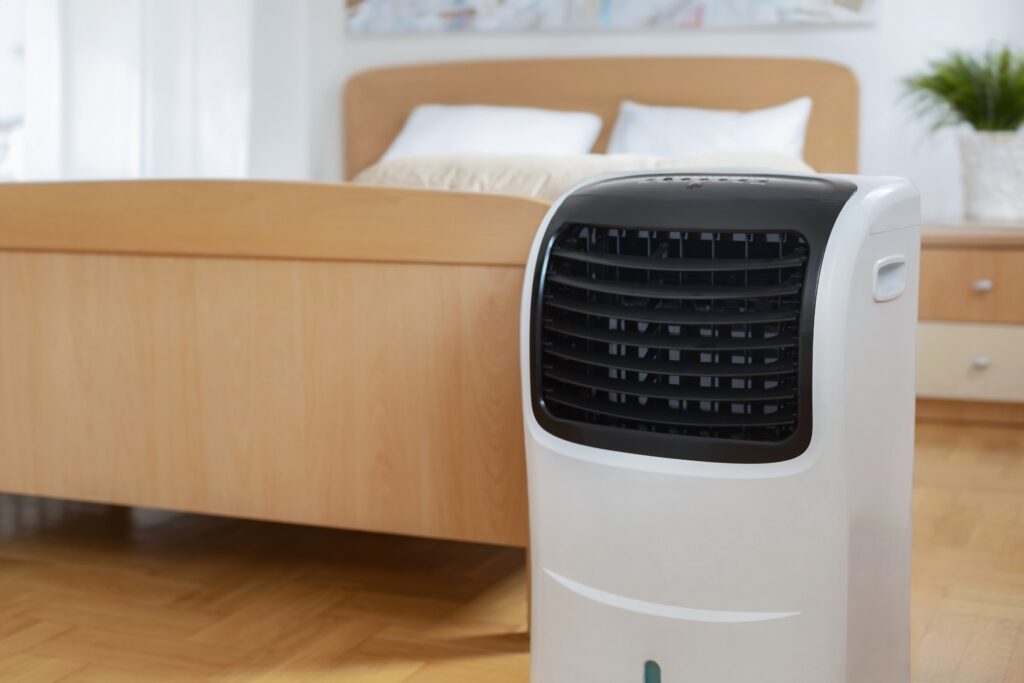
Of course, there are certain drawbacks with this. For example, they are noisier than the permanent split-system or central AC units as the compressor and fan are inside the room. With the permanent systems, the loudest part (the compressor) is instead on the outside.
The cooling capacity is also limited so in high ceiling rooms or open-concept rooms they aren’t as affective. Typically, they can take up a lot of floor space too so can be somewhat unsightly and disruptive if you already have limited room.
A permanent split/wall mounted unit will be more ideal for larger spaces.
Which Portable Air Conditioner is right for me?
As one of the world’s largest air conditioning manufacturers, this is a good place to start for those wanting to cool down in the summer months.
The ‘Midea’ Premium Portable unit comes in two options – a 2.5kW or 3.5kW and are super simple to use. Using the MSMARTHOME APP, users can control the unit from their phone with the desired temperatures and mode being selected from this.
Meanwhile, the Eco Portable Units are more energy efficient, boasting an energy rating of A. These nifty machines are available in 2.1kW and 2.5kW and make for an ideal solution to keep cool in bedrooms or the office.
How do I maintain a Portable Air Conditioner?
To keep your unit running at its best, you should carry out the following when the unit is turned off:
- Clean the air filters every 2 weeks
- Drain the water tank once a month or sooner if the unit notifies you when it needs draining
- Clean the coils with a soft brush or a vacuum equipped with the brush attachment
Look out for a unit emitting a musty or mouldy smell or if the airflow is far less than usual as these are signs a deep clean is needed. If it’s noisier than usual, then this can suggest a build-up of debris. Once you are finished for the season, drain the remaining water left in the tank.
Summary
For those wanting to avoid large upfront fees, portable air conditioners certainly have their place – especially for the UK climate when hot weather is often short lived. If you are a renter, then even better if you’re after that short term solution. However, the most important limitations are that they’re not suitable for large spaces and when compared to window or central AC units, they are also less energy efficient. Therefore, you should consider if you want to prioritise convenience of portable over the long-term performance of the permanent AC unit.